1838 words, 10-minute read.
Content Warning: This post discusses a murder and includes graphic details about the violence towards the victim and a first-hand account from the scene. Please read with discretion.
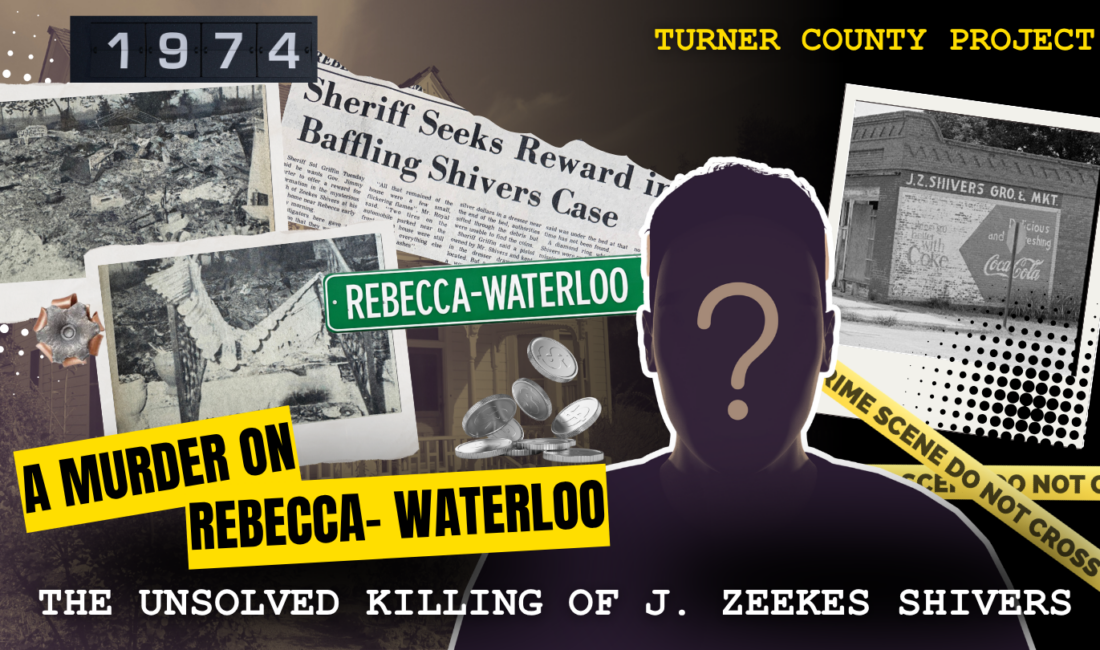
Before the sun rose on the morning of September 20, 1974, a fire consumed a home along Rebecca-Waterloo Road in Turner County. By the time the Turner County Fire Department and Sheriff’s deputies arrived around 6:45 a.m., after receiving a call reporting a house fire, there was almost nothing left to save. In the early morning light, they found the body of J. Zeekes Shivers where his bedroom had been. Shivers was 57 years old.
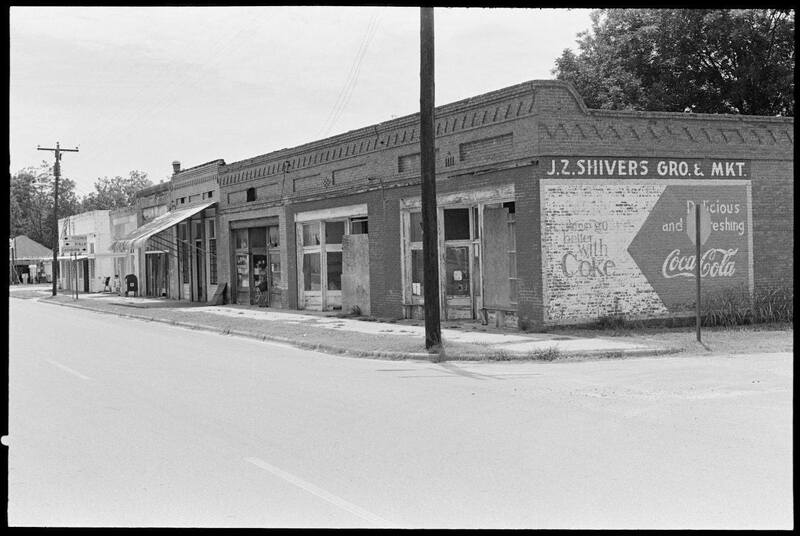
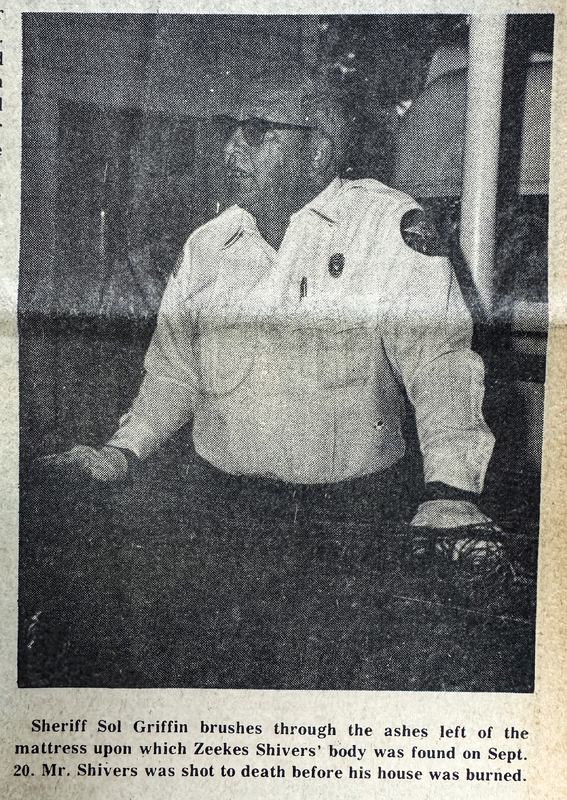
Born October 16, 1916, he was a lifelong Turner County resident, a husband, father, and grandfather, and one of the area’s most prominent businessmen. He owned Shivers Oil Company and J.Z. Shivers Grocery & Market, one of the community’s largest general stores. Sheriff Sol Griffin later noted that Shivers “was known to have carried large sums of money,” a detail that would quickly become central to the investigation.
A Larger‑Than‑Life Merchant
Those who knew Zeekes Shivers remembered him not only as a businessman but as a man whose enterprises seemed to grow as fast as Turner County itself. An off‑the‑record source recalled that the “J” in his name stood for nothing at all- “just the letter J,” a detail that somehow fit his plainspoken personality. He farmed more than 400 acres of cotton, peanuts, melons, and cattle, but it was his stores that made him a local fixture.
Shivers operated three different store locations over the years: the first at his home on Rebecca-Waterloo Highway, the second on Rebecca’s main street, and the third on Highway 112, where Dan King Farms packing shed stands today (11840 GA-112, Rebecca, GA). Locals described the store as “Walmart before there was a Walmart.” Shivers bought salvaged goods from wrecked trucks and trains, stocking everything from tires and chains to evening dresses, wigs, sewing supplies, lumber, barbed wire, and even the popular Converse tennis shoes of the 1970s. He sold produce he grew himself and had freshly cut meat behind the counter. The result was a place where a farmer could buy tractor parts, a child could buy candy, and a housewife could buy a Sunday dress- all under one roof. It was a store for everyone.
His success in his businesses meant that he was flush with cash, and he often had it on him. This reputation for carrying cash and valuable goods would later shape investigators’ theories about his death.
However, the details are murky from the fire, the murder, and afterwards. Even the earliest reports of the fire contain contradictions. Newspapers stated that Edna Jean Shivers (Zeekes’ daughter-in-law) first spotted the blaze, but other sources differ. Another daughter‑in‑law, Margaret Shivers, was said to have been driving to Rochelle at daybreak when she noticed the house was simply “gone,” not smoking or smoldering- just a space where it had stood hours earlier. Phone lines in the area were down, as they often were, delaying the call for help.
At first, the scene appeared to be a tragic house fire. Shivers’ body was later identified by dental records, and initial assumptions leaned toward an accidental death. That narrative collapsed during a routine medical X‑ray.
“A bullet was recovered from the skull after an X‑ray performed as part of a routine medical examination revealed its presence,” investigators said. Shivers had been shot in the head. What had looked like a fatal fire was now being treated as a homicide, with the blaze believed to have been set to destroy evidence.
The fire itself raised immediate suspicions. Shivers did not smoke, and firefighters were struck by how quickly and completely the home burned. “Firemen here are convinced that fuel would have to be added for the house to burn as quickly as it did,” the Wiregrass Farmer reported. The flames were so intense that they ignited Shivers’ automobile parked nearby, destroying it as well. Fireman Henry Royal later said, “All that remained of the house were a few small, flickering flames. Two tires on the automobile parked near the front of the house were still burning, but everything else had turned into ashes.”
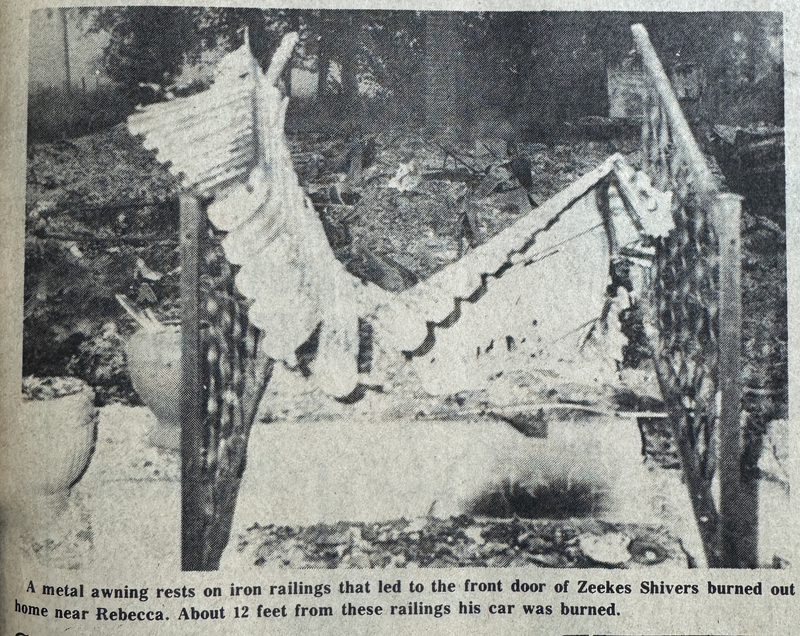
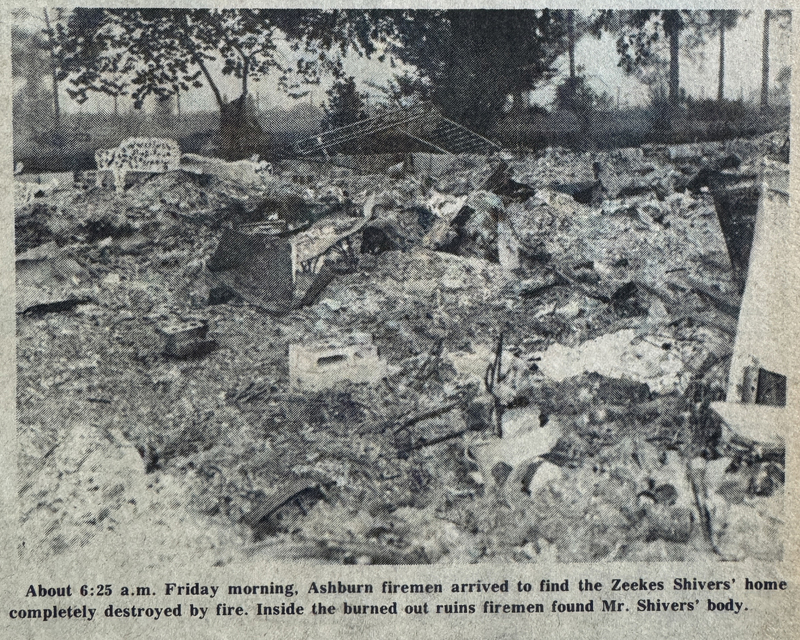
Investigators began to piece together Shivers’ final day. On Thursday, September 19, he traveled to Americus for business with Joe Kooche, a Small Business Administration representative, to discuss the possible purchase of trucks. Kooche had spent the previous night at Shivers’ home. Around noon or early afternoon, Shivers was seen at his store in Rebecca by J.C. Covington. That evening, he ate supper with his son Harold and his family. He invited his grandson to spend the night with him, but returned home around 10:00 p.m without him. His wife, Delena Houston Shivers, whom he had married in 1938, was hospitalized in Florida at the time, and Shivers was expected to leave early the next morning to visit her.
Sometime after returning home, something went terribly wrong. Officers later said Shivers’ wristwatch had stopped at 1:58 a.m., “indicating that the slaying and the fire occurred shortly before that time.” In the ruins of the bedroom, his body was found lying where the mattress had been, his legs and feet off the bottom of the bed. He was still dressed, though evidence suggested he may have been removing his shoes and socks. “A bullet was found in the base of his skull,” Sheriff Griffin said.
Remnants of a .22 rifle were found nearby. “We found that he was shot in the head with a .22 rifle,” Griffin stated, “but the ballistics tests have not been conclusive as to whether he was killed with that rifle or not.” Weeks later, another disturbing detail emerged when a crime lab report revealed that Shivers had been struck on the head with a sharp instrument before his death.
Rumors circulated even then. Some suggested Shivers owed money to gamblers; others believed someone had come to collect a debt or demand cash he did not have. Robbery was considered a probable motive. Sheriff Griffin later disclosed that “a number of silver coins, and possibly Mr. Shivers’ wallet and his diamond ring are missing.” Governor Jimmy Carter offered a $1,000 reward for information, later increased to $2,500 through community fundraising efforts in Rebecca. Still, no leads emerged.
Rumors filled the silence left by the lack of answers. Locals whispered about possible criminal connections and hidden dealings, but even those closest to the case were clear about one thing. “It was just street talk,” one resident later said. “There’s nothing ever been substantiated or confirmed.”
By mid‑October, officials admitted they had no suspects and no clear direction. The Wiregrass Farmer called it “the most brutal crime in Turner County.”
A Firsthand Account From the Scene
Former Ashburn Police Officer Kenneth Bryan, who responded to the scene that morning, 50 years later, offered a stark recollection of what he found. He remembered arriving after Deputy E.L. Bean and speaking with him near the ruins of the bedroom. Bean told him that Shivers had been sitting on the edge of his bed when the fire overtook him- still dressed in work pants and boxer shorts. The position of the remains, Bryan said, suggested that Shivers had been talking to someone he knew shortly before the attack. “He was sitting on his bed and had clothes on,” Bean told him. “So he probably knew who it was.” J. Zeekes Shivers was no small man. He was 57, in the prime of his life, and according to his WWII draft card, he was nearly 6 feet tall. He was a physically imposing man.
The body was taken to Perry Funeral Chapel, where Bryan and Coroner Edgar Perry searched for any surviving evidence. Using wooden tongs, they recovered what remained of Shivers’ clothing and delivered it to the Turner County Sheriff’s Office. Only later, at the hospital, did an X‑ray performed by Dr. Goss reveal the bullet inside the skull. Bryan recalled watching as Doctor Goss traced the unusual path: entering near the eye, striking the back of the skull, traveling downward, then flipping upward to rest near the base. “You could actually see the line of where the bullet had hit and went down and went around,” recalled Bryan. “That was the first time I have ever seen that. The only time I have ever seen it.” The intense heat from the fire had flattened the bullet beyond use for ballistics.
Bryan also shared a detail that never appeared in the newspapers. According to what he was told at the time, the Georgia Bureau of Investigation had quietly developed a suspect. Agents reportedly followed a trail to the Veterans Hospital in Dublin, but the trail ran cold before they ever found the person of interest. No name was ever released, and the lead evaporated as quickly as it surfaced.
As for the fire itself, Bryan believed the age of the house contributed to the speed of the burn- old, dry wood ignites fast- but he did not rule out the possibility of an accelerant. “It could have been gasoline,” he said, echoing early suspicions from firefighters who felt the blaze moved too quickly to be accidental.
More than fifty years later, the death of J. Zeekes Shivers remains unanswered. What began as a house fire before dawn revealed itself to be something far more deliberate, yet no arrest was ever made, no suspect ever formally named. The questions that surfaced in 1974 have never been put to rest.
In an effort to learn more, the Turner County Project submitted an open records request to the Georgia Bureau of Investigation. The response was brief but telling: “The records in this case are part of a pending investigation or prosecution. Pursuant to O.C.G.A. § 50-18-72(a)(4), the records are not subject to disclosure until the investigation/prosecution is concluded, which includes the appeals process.”
That single statement keeps the door cracked open. It suggests that somewhere, in a file that has not seen daylight in decades, this case is still considered active. Whether that means there are leads, evidence yet to be tested, or simply a file that has never been formally resolved, it is impossible to say.
What is certain is this: on a quiet stretch of the Rebecca–Waterloo Road, a man was murdered in his own home, and the full circumstances of what happened before morning has never been fully established. The fire burned fast, but not fast enough to take the story with it.
Today, the murder of J. Zeekes Shivers remains one of Turner County’s enduring mysteries, a true crime that still lingers just beneath the surface, waiting for answers that have not yet come.
Want to read the newspaper articles yourself?
Click here to check out the TCP Archive tag for all things J. Zeekes Shivers!



To see this story of my family come to light again has me so emotional and hopeful that we can finally find out what exactly happened.
It is my hope that possible memories are prompted and maybe a break in the case will happen! ❤️
Amen!!!