3,803 words, 20 minutes read time.
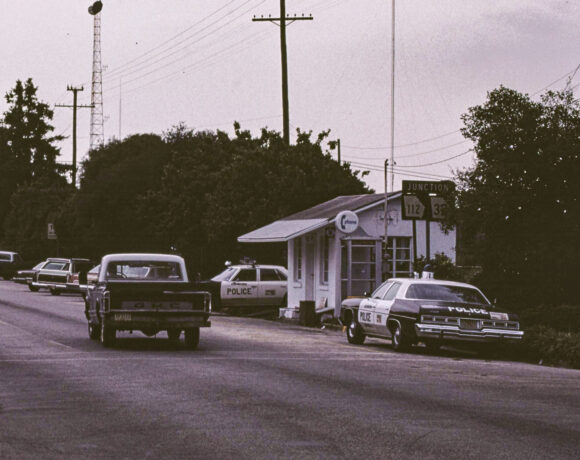
Most of us drive past the Turner County Sheriff’s Office today without a second thought. But decades ago, that same stretch led to a place that built a lot of infrastructure within Turner County and changed many lives in the process.
Check out this deep dive into the Turner County Public Works Camp, the chain gang era, and the complicated legacy it left behind in our corner of Georgia. This story doesn’t fit neatly into one box. It starts in the shadow of Reconstruction, runs through decades of forced labor, loss, reform, and concludes with a potential scandal when the gates closed in 1971.
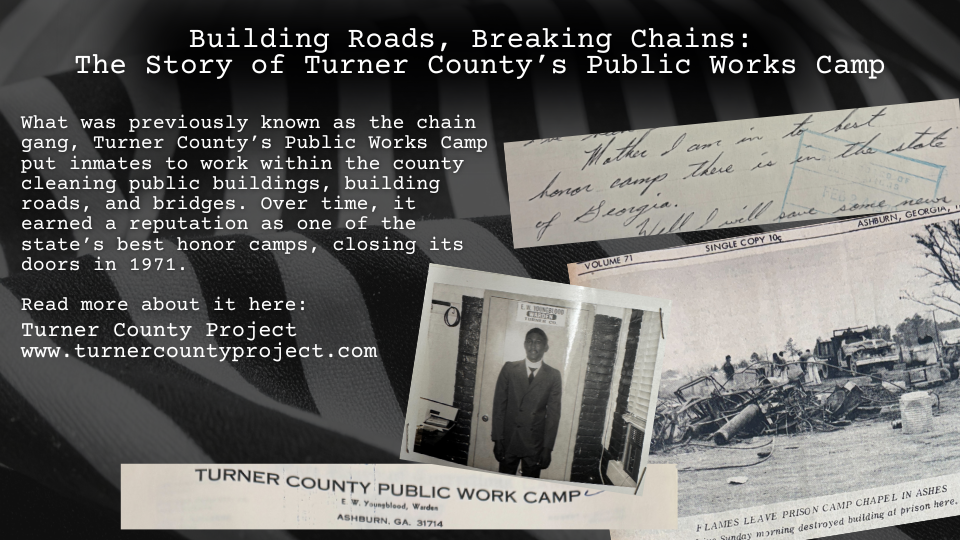
The work camp helped build local roads, cleared land, repaired bridges, farmed crops, made syrup, and functioned like a small, self-contained town. By the 60s and 70s, it had a reputation for rare humanity under Warden Edgar Wayne Youngblood, where inmates played softball on Sundays and wrote letters home describing the camp as “the very next thing to being free.”
But the past carries more than one truth. There are stories of exploitation and racial injustice, an inmate killed and ruled “accidental” in 1931, and a rumored scandal that a former convict, Winfred Rembert, recounted that may have been the real spark that ended it all.
The TCP went heavy on research here. Archives visits, direct quotes, personal interviews, old newspaper clippings, footnotes, bibliography, the whole thing. It’s long (so grab a coffee if you do click), but if you love understanding the roots of this place we call home, it’s worth the read.
If you’ve ever wondered who built it, who paid for it, who lived through it, or what really happened out there… the answers might surprise you.
Jump to section:
- The Early Years of Convict Lease Labor (1866-1908)
- The Birth of the Chain Gang (1908-1943)
- Turner County Public Works Camp (1920-1971)
- The Incident That Closed the Camp
- The Public Works Camp in Retrospect
- Staff of the Public Works Camp
- Bibliography
- Footnotes
The Early Years of Convict Lease Labor (1866-1908)
The story begins in the early 1900s. During the time of Reconstruction post-Civil War, throughout a majority of the South, populations were reckoning and trying to figure out how to rebuild their devastated, war-ravaged buildings while also somehow resubjugating recently freed enslaved people. The majority wanted to continue to exploit their labor at minimal costs, but they had to create legal systems due to the 13th Amendment.
“Neither slavery nor involuntary servitude, except as a punishment for crime whereof the party shall have been duly convicted, shall exist within the United States, or any place subject to their jurisdiction.”
13th Amendment to the U.S. Constitution: Abolition of Slavery (1865)
Taking advantage of that exception loophole in the 13th, so formed by the General Assembly of Georgia in 1866, the following: “It also passed an act on March 20, 1866, to provide that the Inferior Courts of the individual counties use convicts on public works or to hire them out to contractors engaged in such work.”1 Prisoners- most of them Black men- were forced into grueling labor, chained together long before the term “chain gang” ever existed. They worked on public projects such as building roads, clearing land, or farming under harsh and dangerous conditions. Though it was presented as a way to punish crime and maintain order, the chain gang became a symbol of racial injustice and exploitation, especially under Jim Crow laws. Prisoners were often sentenced for minor offenses or false charges and faced brutal treatment, poor living conditions, and little chance of rehabilitation.
Even in counties like Turner County, where plantation slavery never really existed due to the area not being settled until later, racial attitudes against Black people remained deeply entrenched. As a result, the county still became part of the broader system of convict leasing and penal labor- a new form of control and economic exploitation. Turner County once contracted its misdemeanor convicts to private companies through the convict leasing system.
In 1908, county officials signed agreements with J. S. Betts & Company, a local sawmill where 46 convicts worked2, and with Conolly & Pinson (also recorded as Conly & Pinson), allowing these businesses to use county prisoners in their operations. While little is known about the conditions at J. S. Betts & Company, more details survive from the Conolly & Pinson case, which reached the newspapers and the courts after allegations of whipping abuse.
“[T.A.] McDonald was convicted of assault and battery upon one Dave Cook, whom the testimony shows he had whipped. He attempted to justify the battery by showing that he was the whipping boss of the Turner county chain gang, in which Cook was a misdemeanor convict, and that the latter had been guilty of refusing to work and of acts of insubordination by attempting to take a gun from one of the guards. The place where the whipping occurred was spoken of in the evidence as being the chain gang of Conolly & Pinson…3 There was even an article in The Waycross Journal about the conditions of the convict camps and their having violated “the rules of the prison commission…”4
In 1908, a committee of the General Assembly of Georgia was appointed to investigate reports of cruelty and nepotism in the prison system. One can assume that, as a result of that report, was why Georgia officially outlawed the convict lease system.5
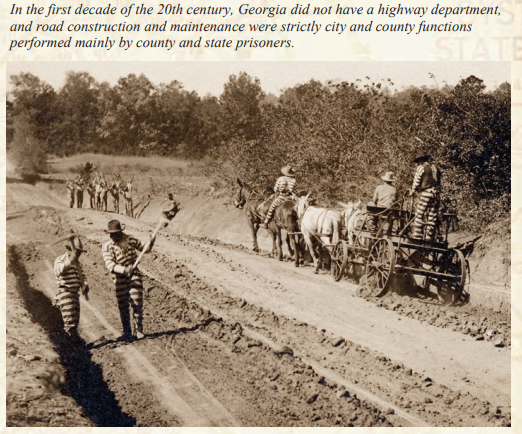
In practice, though, counties like Turner simply shifted from convict leasing to county-run camps.6 Chain gangs brought Georgia into the modern age and jump-started its tourist economy by improving mobility via its road network. They, in fact, were responsible for the construction of what was known as The Dixie Highway, which we know today as US Highway 41.7 But that is only the beginning.
The Birth of the Chain Gang (1908-1943)
Early chain gangs were little better than the convict leasing systems that came before them. Black men- often the overwhelming majority, even in Turner County- were shackled together and forced into grueling labor on roads, bridges, and farms.8 Striped uniforms marked them as prisoners, and punishments were both public and humiliating, a constant reminder of their powerlessness.
By 1931, Georgia prisons had officially stopped whipping as a punishment, according to John Spivak in Hardtimes on a Southern Chain Gang. Instead, guards relied on “restricted movement” for a set period, usually an hour. This notorious method, called the “restraining posture,” required men to be bent over at the waist, though most collapsed and fainted in pain before the time was up.9 In the Turner County Works Camp, Sheldon Cook described seeing isolation boxes at the camp. They were not large, but he remembers seeing three of them spaced apart for unruly prisoners, although he never saw them in use on his visits as a teenager. “They had old, wooden boxes out there where they put the mean prisoners when they got out of line. It wasn’t very big. They were probably 3 feet by 3 feet and 6 feet long. Best I can remember, there were 3 spaced out.”
The system worked in the favor of the authorities, not the prisoners. Sheriffs and deputies earned money from arrests, while local courts and prosecutors, unpaid otherwise, collected fees from defendants. Entirely, the justice system profited from the confinement of human labor. Political pressures compounded the problem: officials sought to appear tough on crime to win favor with voters.
Those who could not pay their fines often spent weeks, months, or even years on the chain gang. Labor was relentless: dawn to dusk on weekdays, half-days on Saturdays, with baths only on Saturdays and visitors on Sundays. They earned no wages, yet the counties collected taxes for public works and charged private businesses for their labor. Every aspect of the system rewarded incarceration, leaving men trapped in a cycle of forced work and indignity.
For the people of Turner County, the presence of the chain gang was a part of everyday life. Residents recall seeing trucks loaded with prisoners being hauled to work sites. Children who played along country roads sometimes received sugar cane stalks tossed down from convicts riding in the back of work trucks.10 These men were a visible part of the landscape.
In 1938, Governor E.D. Rivers, as part of his “Little New Deal” reforms, ordered that the phrase “chain gang” no longer be used, replacing it with the softer term “public works camp.” Still, these work crews remained in operation until 1943, when Governor Ellis Arnall officially brought the chain gang system to an end.11 This reform became more humane, removing all forms of shackles, manacles, picks, leg irons, and chains, which caused debilitating pain and health problems to the incarcerated individuals.

Turner County Public Works Camp (1920-1971)
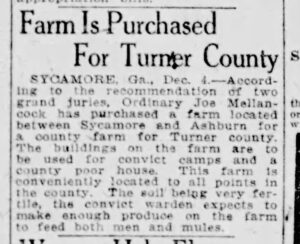
By 1920, Turner County had established a permanent convict camp and farm on Pine Knot Road, according to correspondence. It became its own small community, with a “Big House” for the warden and his family and barracks for inmates. At its peak, the camp held 50 to 70 prisoners.
The camp provided labor for almost every kind of county work. Crews cut weeds from ditches, repaired roads and bridges, planted and harvested crops, and even made syrup. Trustees were sent into town to clean the courthouse, run errands, or work at the Turner County hospital. For some, it was startling to see men in striped uniforms sweeping the courthouse steps. For others, it became so common that they barely noticed.
Sundays brought a touch of normal life. Inmates often played softball on the camp’s field, drawing spectators from the community. “The inmates were allowed to play baseball on Sunday afternoons. My brother, Robert, and I would go watch,” remembered Ruth Smith Waldow, daughter of former Warden Robert E. Smith.
Sheldon Cook recalls many Sundays coming down to the Public Works Camp and playing softball with the inmates in the late 1960s when his dad, Theron Cook, was a deputy at the camp: “I don’t know what year it was, I must have been probably 12 or 13 years old. I want to say probably [19]68 because he [his dad, Theron] only worked there for probably a year, him and Tump Haman… We used to go up on Sunday afternoons and play softball with the prisoners. It was quite an experience, and I remember that some of the stuff those prisoners would do, that you would never dream of… We always played by the rules, but they didn’t have any rules. If they wanted to bunt the softball, run the wrong way, or whatever, it was all good with them. It was kind of interesting.”
Death of a Work Camp Inmate
In April 1931, nineteen-year-old John Wesley Kendall, a Black inmate at the Public Works Camp, was killed under what officials described as accidental circumstances.12 According to historical records, Kendall had been serving a sentence of ten to fifteen years for manslaughter when he was shot and killed by a guard named J. J. Conner on April 25, 1931. The death record lists the cause as an “accidental death,” a classification that was quickly affirmed by a local jury.
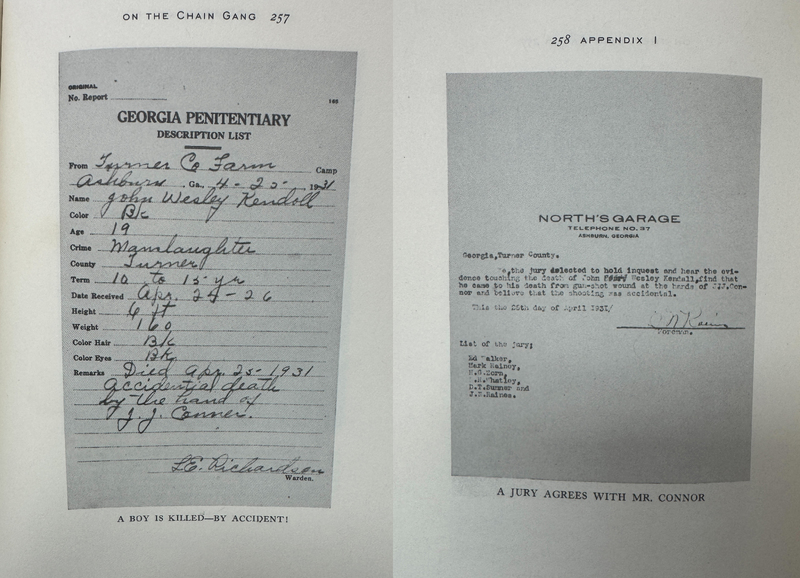
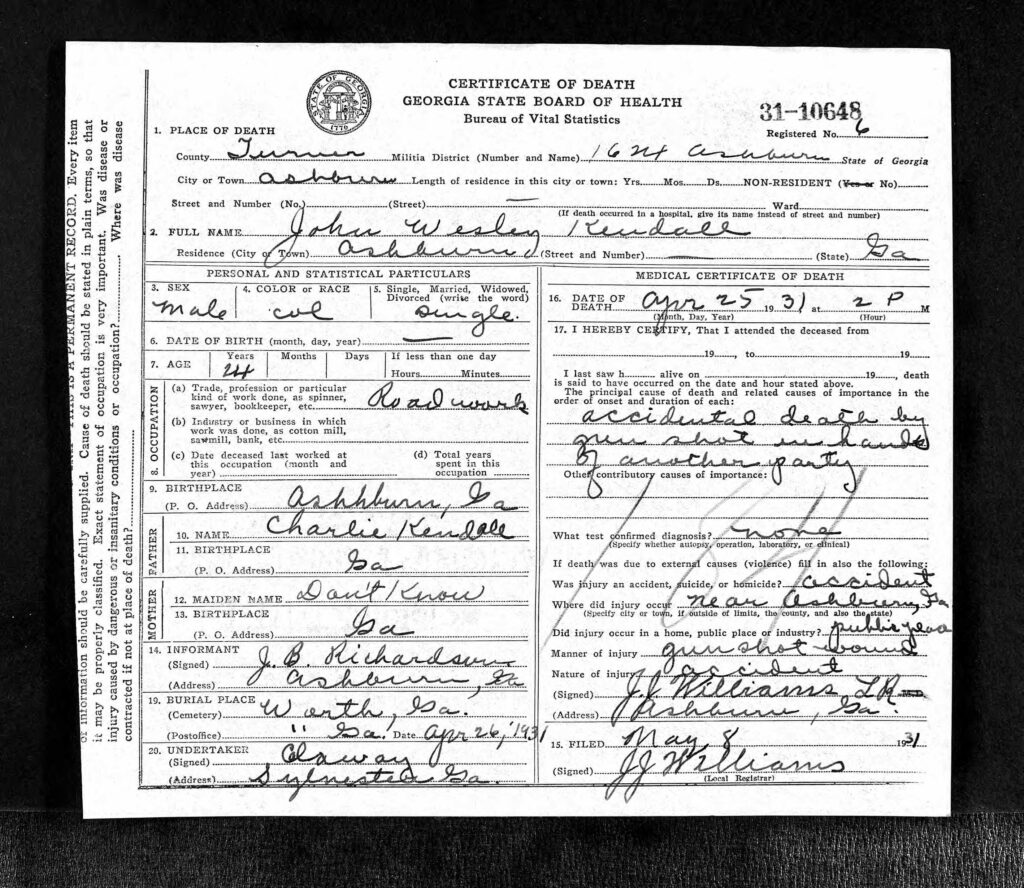
A typed statement on letterhead from North’s Garage in Ashburn, where the inquest was held, reports that the jury concluded Kendall’s death resulted from an accidental gunshot wound “at the hands of J. J. Conner.” The document, dated April 25, 1931, bears the signature of the jury foreman and the names of six jurors, all local White men. While the official finding cleared Conner of wrongdoing, the brief and informal nature of the inquest raises questions about the conditions and oversight at the Turner County Public Works Camp during this period.
Kendall’s death, like many others that occurred within Georgia’s chain gang system, reveals the precariousness of life for inmates laboring under state and county control. Even when fatal incidents were documented, they were often reduced to paperwork and ruled accidental, leaving little room for investigation or accountability.
Winfred Rembert’s Memories
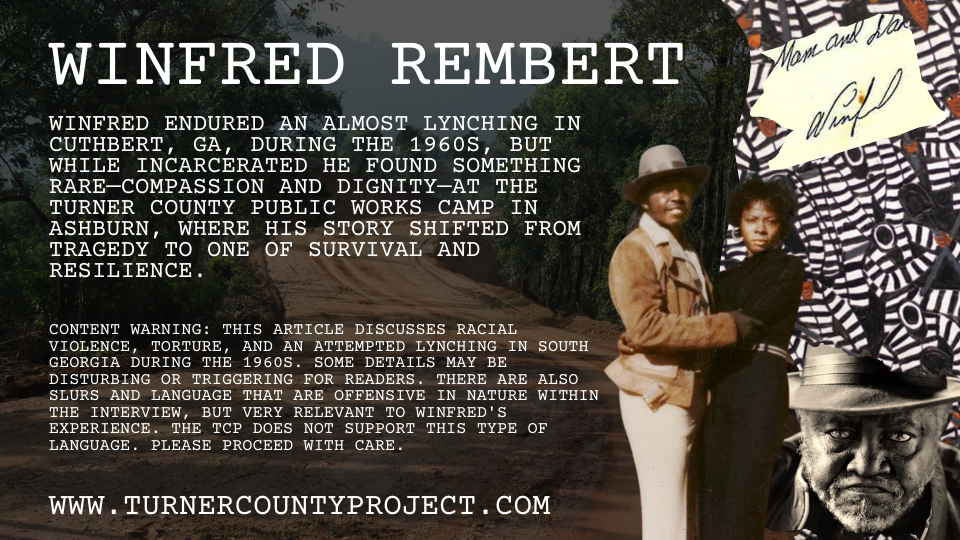
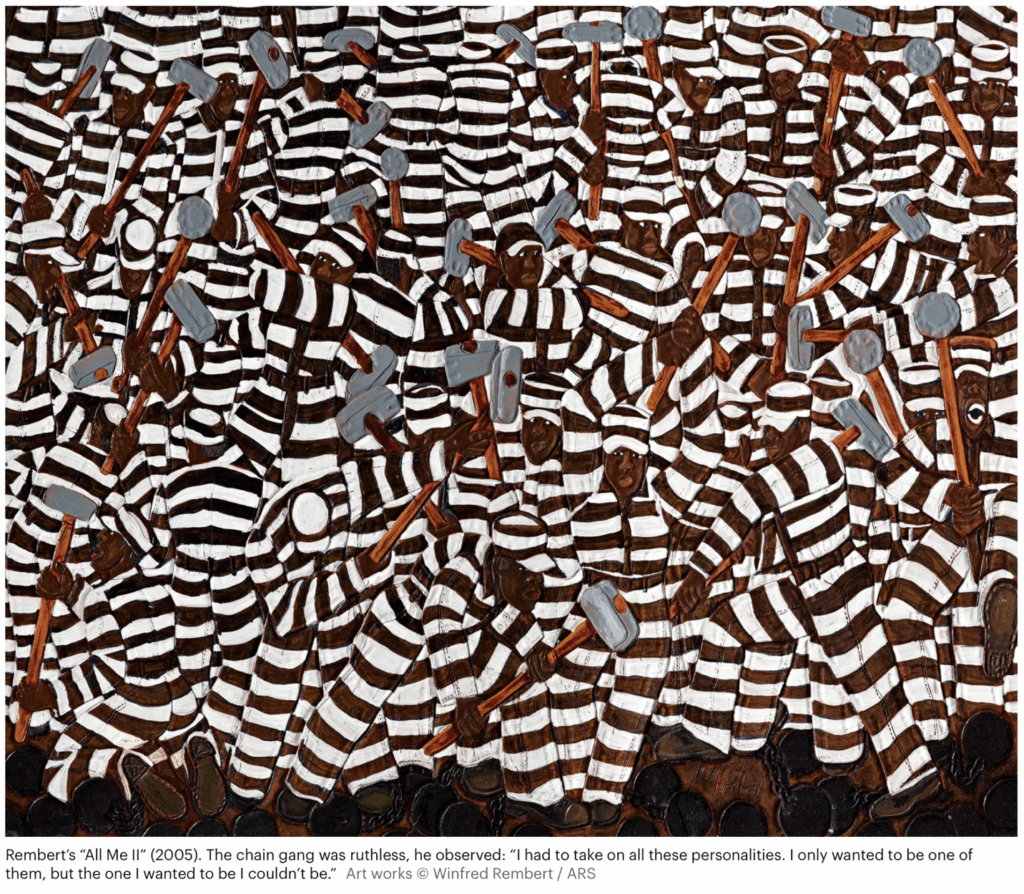
Artist Winfred Rembert, who spent time at the Turner County Public Works Camp in the late 1960s early 1970s before it closed, wrote about his experience in his memoir Chasing Me to My Grave: An Artist’s Memoir of the Jim Crow South. His recollections provide a vivid portrait of daily life under Warden Edgar Wayne Youngblood.
“We had arrived at a small state penitentiary work camp. It was the Turner County Public Work Camp in Ashburn, Georgia. There were twenty-five to thirty guys at the camp. They were all wearing black-and-white striped uniforms, except a few who had been there a long time. If you had been around there a long time, and you worked hard, they would give you pants with a single stripe straight down the side and you could wear any shirt you wanted.”13
Rembert recalled how Youngblood allowed inmates to play several sports, sometimes even against the local high school team. Rembert even gave insight into daily life at the camp: “Some guys were sitting around talking with their girlfriends, who had come to visit. Others were playing basketball. There was no guard outside, and inside there were no cells, which was an improvement over where I just come from. Instead they had one big sleeping area for everybody. I thought maybe this was a good place after all. Youngblood took me to my space and I packed my clothes in a little chest upside the bed. He introduced me to the cook, whose name was Berry, and to another man, who was a guard. The guard was an old guy. They called him ‘Crip’ [E.A. Zorn] because he had a clubfoot.”14
Life at the camp carried a surprising amount of freedom compared to harsher prisons. “In small camps like that one, the warden did what he wanted to do,” Rembert explained. “Women would come visit the inmates and there were some little houses where folks could go for privacy. You got a little house with a bed, couch, and all that. If you worked hard for Youngblood, he would look out for you.”
Wardens and Their Influence
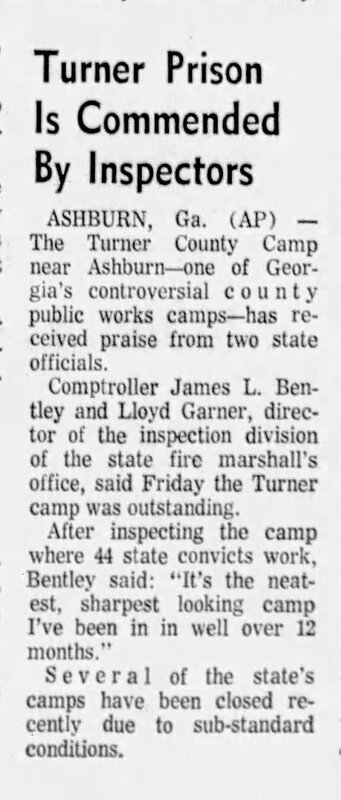
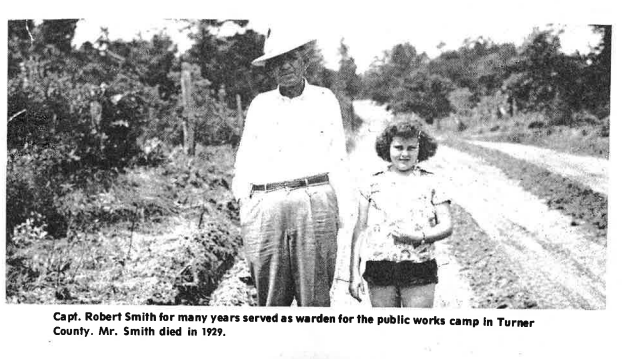
The names of the wardens mark the passage of time. In 1930, Leon E. Richardson was in charge. Later came Clyde Lamar Hannah and Robert E. Smith. Each man ran the camp in his own way, with varying levels of severity and reform.
But it was Warden Edgar Wayne Youngblood, from 1966 to 1971, who left the deepest impression, or at least the most historical record that can be referred back to. He made improvements to safety and sanitation, added a laundry and fire equipment, and created recreational and educational opportunities.15 For many inmates, he earned a reputation as fair and humane.
Letters from the period echo Rembert’s account. One inmate wrote in 1970:
“I am in a camp that I am so very well pleased with, one in which a man can serve his sentence without any complications of any kind. It is the very next thing to being free.”16
Another wrote home:
“I have a real good deal here in this camp. I could not ask for anything better. It is the best honor camp there is in the state of Georgia.”
Visit the Turner County Project Store and wear your hometown pride today!

The Incident That Closed the Camp
Southern states continued to use chain gangs well into the 1960s. Their decline after World War II had less to do with growing concern for human rights and the Civil Rights Movement and more to do with practical and economic changes. The rise of heavy machinery made manual labor less useful for road construction and maintenance, and new federal highway grants prohibited the use of convict labor on public projects. As a result, states began building larger penitentiaries for long-term incarceration, while county work camps became increasingly expensive to maintain. By 1970, many of the old Black Code laws that had fed the convict leasing and chain gang systems were either repealed or rendered obsolete by Civil Rights legislation.
Turner County’s Public Works Camp finally closed in 1971. The Wiregrass Farmer attributed the closure to financial strain, but Winfred Rembert’s memoir offers a more scandalous explanation. In his account, a guard named Sonny Cole had an affair with a local woman. When her husband unexpectedly came home, chaos erupted as Cole fled, Rembert sped away in a truck to help him escape, and the enraged husband later returned home and killed his wife. According to Rembert, the community blamed the camp’s lax supervision for the tragedy, saying the inmates had been given too much freedom by the guards and warden.
“One time, after I had been at camp for about two years, Sonny Cole and I went by this woman’s house. Sonny and her had a thing going. He parked the truck and went in to see her. But as soon as he got in the house, the husband drove up. The guy was going up the steps and Sonny came running out of the door and ran over the top of him. I’m sitting there in the truck watching every move. Then I started the truck up and began creeping off. I said, ‘Jump, Sonny! Jump!’ and he jumped on the back of the truck. By the time the guy had his gun and began to follow us. I drove way out in the country. I was driving fast on those country roads and this guy couldn’t catch us.”17
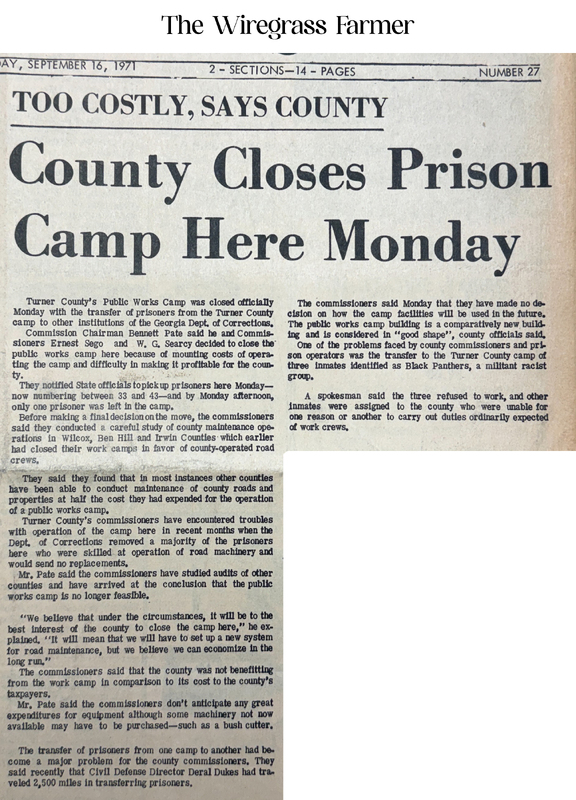
While county officials publicly cited rising costs, Rembert’s story suggests that the scandal surrounding the murder and the public outrage that followed may have been the true reason Turner County’s camp finally shut its gates. Despite some research into the alleged scandal, a brief review of the Wiregrass Farmer’s front pages from that period reveals no story about a murdered wife. It remains unclear what the official cause of the camp’s closure truly was.
The Camp in Retrospect
By 1974, the land had been repurposed for county offices, including the Agricultural Stabilization and Conservation Service and the 4‑H program. In 1975, the Turner County Board of Commissioners allowed the Turner County High School Agriculture Forest Program to use 4.8 acres of the former camp property, which was cleaned up and planted with pine seedlings.18 The barracks and fields disappeared, and the physical reminders of the camp faded.
For some, the phrase “chain gang” still evokes trauma experienced, recalling mostly Black men in stripes breaking rocks under the watch of armed guards. For others, the Turner County Public Works Camp represents something different- a place where, against the odds, men could experience a small measure of freedom amid confinement. As Winfred Rembert remembered, “Youngblood was all right. He treated us well until they shut the place down.”
The history of the camp is a reminder that systems of oppression and resilience often coexist, and that memory carries both pain and meaning. While the structures are gone, the stories endure- testaments to human endurance, the complexities of justice, and the ways communities, such as ours, must reckon with difficult pasts.
Staff of the Public Works Camp
Wardens
- Leon E. Richardson (1930 Warden per Census – 1932)
- Kindred G. Pierce (Jan. 1949 – June 6, 1949)
- Robert Brooks (acting warden after Pierce’s removal)
- Seaborn Sumner (July 1, 1949 – 1950 Warden per Census)
- Harvey B. Gill (December 3, 1950-November 1952)
- W.L. Thompson (Nov 1952 – Jan. 1953)
- Robert Smith (1953- 1966), retired after 14 years
- Edgar Wayne Youngblood – (Nov. 1, 1966 – March 1971)
- Deral Dukes (March 1971 – May 18, 1971)
- Clyde Lamar Haman (1971 – ?)
- John David Gray (5/18/1971)
Deputy Wardens
- Robert Brooks (? – July 15, 1949)
- Dave Roland (? – Aug. 1, 1949)
- Harold Whiddon (April 13, 1948 – ?)
- McDaniel Warren (1950-Feb 1950)
- Guy Otto Alberson (Feb 6, 1954 – ?)
- John Harold Watson (? – March 1969)
- Ernest Wallace (March 1969 – ?)
- Theron Cook
- E.A. “Crip” Zorn (January 1970)
Physicians
- J.H. Baxter (May 25, 1942 – 1948)
- CC Goss (1948-1956)
- W.K. Stewart (June 1956 – ?)
Other Misc. jobs:
- Shotgun Guard: A.K. Wilson
- Prisoner Transfer Office: Deral Dukes (in 1971, worked for “many years” in this position)
- Teachers for Education Program:
- John Dye
- Edward E. Mitchell, Jr.
Bibliography
Acts of the General Assembly of the State of Georgia, Special Session, 1943. https://dlg.galileo.usg.edu/data/dlg/zlgl/pdfs/dlg_zlgl_186967056.pdf
Bob. Letter to Robert Brownlee. Ashburn, GA: Turner County Project Digital Archive Repository, February 14, 1970. https://turnercountyproject.com/archive/items/show/1026
“Death of Public Works Inmate John Wesley Kendall,” Turner County Project Digital Archive Repository, accessed October 23, 2025, https://turnercountyproject.com/archive/items/show/1020.
Georgia. General Assembly. House of Representatives. “Journal of the House of Representatives of the State of Georgia at the extraordinary session of the General Assembly at Atlanta, Tuesday, August 25, 1908.” 1908. November 5, 2025. https://dlg.galileo.usg.edu/do:dlg_ggpd_y-ga-bl404-b1908-bspec-p
Georgia. Prison Commission. Report of the Prison Commission of Georgia. Atlanta, Ga.: Franklin Printing and Publishing Company, 18981937, https://catalog.hathitrust.org/Record/100403811.
Jackson, Ed, “Whatever Happened to Georgia’s Dixie Highway?” https://georgia-exhibits.galileo.usg.edu/spotlight/convict-labor/feature/state-run-chain-gangs-and-public-works
Kelly, Erin I., and Bryan Stevenson. Chasing me to my grave. S.I.: Bloomsbury Publishing, pages 126-138, 2021.
“McDonald v. State.” vLex. Accessed September 29, 2025. https://case-law.vlex.com/vid/mcdonald-v-state-1-907805318.
Records of the Georgia Prison Commission, 1817-1936. A part of the records of the Georgia Board of Corrections, Record Group 21. prepared by the students of the 1969 Archives Institute § (1969), https://dlg.galileo.usg.edu/data/dlg/ggpd/pdfs/dlg_ggpd_s-ga-bs700-pa7-bm1-b1969-bp7.pdf
Spivak, John. Hardtimes on a Southern Chain Gang. New York: International Publishers, 1932.
“Transcript of interview of Winfred Rembert,” Turner County Project Digital Archive Repository, accessed September 23, 2025, https://turnercountyproject.com/archive/items/show/1078.
“Turner County Board of Commissioners Minutes (August 18, 1975),” Turner County Project Digital Archive Repository, accessed October 24, 2025, https://turnercountyproject.com/archive/items/show/1095.
Turner County Project Digital Archive Repository, Collection: Turner County Public Works Camp, https://turnercountyproject.com/archive/collections/show/27
“Warden Job Description per Turner County Ordinances,” Turner County Project Digital Archive Repository, accessed September 23, 2025, https://turnercountyproject.com/archive/items/show/1079.
Youngblood, Edgar Wayne. Letter to Asa D. Kelly Jr., Ashburn, GA: Turner County Project Digital Archive Repository, December 27, 1967, https://turnercountyproject.com/archive/items/show/102.
Footnotes
- Records of the Georgia Prison Commission, 1817-1936. A part of the records of the Georgia Board of Corrections, Record Group 21. prepared by the students of the 1969 Archives Institute § (1969), page 2, https://dlg.galileo.usg.edu/data/dlg/ggpd/pdfs/dlg_ggpd_s-ga-bs700-pa7-bm1-b1969-bp7.pdf ↩︎
- “Report of the Prison Commission of Georgia – 1907,” https://turnercountyproject.com/archive/items/show/1124, Page 21 ↩︎
- “McDonald v. State,” vLex, accessed September 29, 2025, https://case-law.vlex.com/vid/mcdonald-v-state-1-907805318. ↩︎
- The Waycross Journal, September 11, 1908, Image 6. https://gahistoricnewspapers.galileo.usg.edu/lccn/sn89053271/1908-09-11/ed-1/seq-6/#words=camps+convict+counties+Turner ↩︎
- Georgia, General Assembly, Journal of the House of Representatives of the State of Georgia at the Extraordinary Session of the General Assembly at Atlanta, Tuesday, August 25, 1908 (Atlanta: State Printer, 1908), accessed November 5, 2025, https://dlg.galileo.usg.edu/do:dlg_ggpd_y-ga-bl404-b1908-bspec-p, page 240. ↩︎
- Records, page 4. ↩︎
- Ed Jackson, “Whatever Happened to Georgia’s Dixie Highway?,” https://georgia-exhibits.galileo.usg.edu/spotlight/convict-labor/feature/state-run-chain-gangs-and-public-works ↩︎
- See Census Records from the Work Camp that reflect the race of each inmate at the time of each census recording: See 1910 (hard to read), 1930, 1940, & 1950 census records. Every single inmate in the 1930 census was Black. Census records from 1960 & 1970 are still not available to the public due to privacy reasons. ↩︎
- Ibid, page xi-xii ↩︎
- Belinda Dill ↩︎
- Acts of the General Assembly of the State of Georgia, Special Session, 1943. https://dlg.galileo.usg.edu/data/dlg/zlgl/pdfs/dlg_zlgl_186967056.pdf ↩︎
- According to the 1930 Census records, John Wesley Kendall is listed, but his age in 1930 is 23. It is unknown which is age correct, whether the census records or the age listed on the 1931 incident. He worked on the chain gang on the road and could not read or write. See census records here, line 65: https://turnercountyproject.com/archive/items/show/963 ↩︎
- Winfred Rembert and Erin I. Kelly, Chasing Me to My Grave: An Artist’s Memoir of the Jim Crow South (Bloomsbury Publishing, 2021), page 131. ↩︎
- Ibid. ↩︎
- Edgar Wayne Youngblood to Asa D. Kelly Jr. (Ashburn, GA: Turner County Project Digital Archive Repository, December 27, 1967). https://turnercountyproject.com/archive/items/show/1027 ↩︎
- “Uncle” Bob to Robert Brownlee (Ashburn, GA: Turner County Project Digital Archive Repository, February 14, 1970). https://turnercountyproject.com/archive/items/show/1026 ↩︎
- Rembert, pg. 138 ↩︎
- Turner County Board of Commissioners, Minutes 18 August 1975, https://turnercountyproject.com/archive/items/show/1095 ↩︎


Leave a Reply